
dBm to Watts Calculator
99.7% Fastest dBm ↔ Watts Converter
You’re staring at a spec sheet that says “23 dBm” and you need a number in watts, right now. Or maybe it’s the opposite — your amplifier is rated for 5 W and you need it in dBm to match the rest of your link budget. Either way, this conversion is one of the simplest things in RF engineering once you’ve seen it done a few times.
Quick Answer
dBm is a logarithmic unit of power referenced to 1 milliwatt. To convert it to watts:
Watts = 10^(dBm ÷ 10) ÷ 1000
The two anchor values worth memorizing: 0 dBm = 1 mW, and 30 dBm = 1 W.
| dBm | Watts |
|---|---|
| 0 dBm | 0.001 W (1 mW) |
| 20 dBm | 0.1 W (100 mW) |
| 30 dBm | 1 W |
| 40 dBm | 10 W |
What Is dBm, and Why Does RF Use It Instead of Watts?
dBm stands for decibels relative to one milliwatt. It’s a logarithmic way of expressing power, and the reason RF and telecom engineers reach for it instead of plain watts comes down to one practical problem: wireless signal power spans an enormous range, from tens of watts at a transmitter down to trillionths of a watt at a receiver hundreds of miles away. Writing those numbers in watts means constantly juggling scientific notation. Writing them in dBm means you’re usually dealing with numbers between about -120 and +50 — small, easy to work with, and easy to add and subtract.
That last part is the real payoff. In a link budget, you don’t multiply gains and losses together — you add and subtract them, because decibels are logarithmic. Transmit power in dBm, minus cable loss in dB, plus antenna gain in dBi, minus path loss in dB, equals received power in dBm. Try that same calculation in watts and you’re multiplying and dividing awkward fractions at every step. dBm turns a link budget into simple addition.
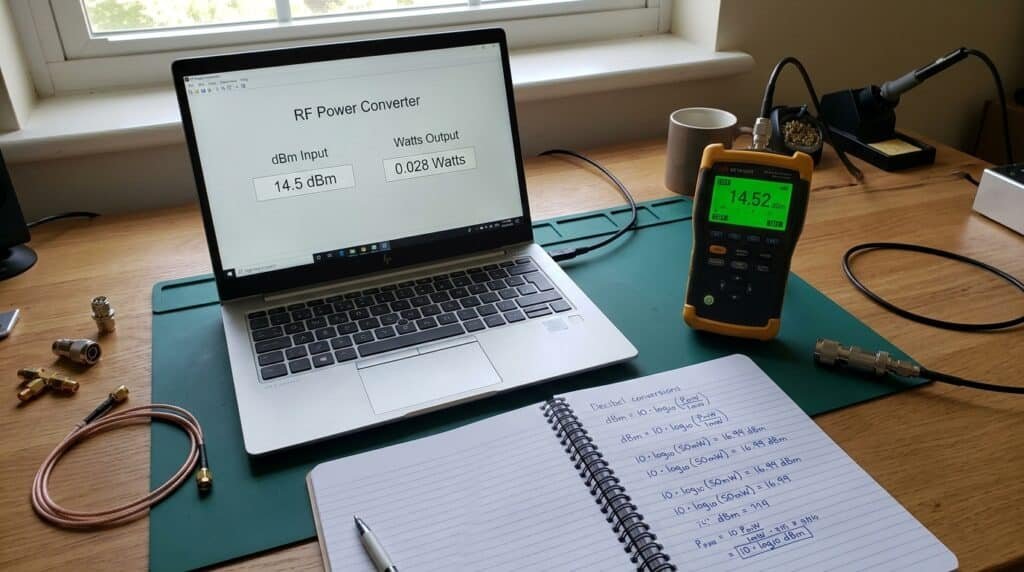
The dBm to Watts Formula
dBm to Watts: P(W) = 10^(dBm ÷ 10) ÷ 1000
dBm to Milliwatts: P(mW) = 10^(dBm ÷ 10)
Watts to dBm: dBm = 10 × log₁₀(P(W) × 1000)
Milliwatts to dBm: dBm = 10 × log₁₀(P(mW))
| Symbol | Meaning |
|---|---|
| dBm | Power in decibel-milliwatts |
| P(mW) | Power in milliwatts |
| P(W) | Power in watts |
| log₁₀ | Base-10 logarithm |
The formula looks more intimidating written out than it is to actually use — you’re raising 10 to a power, then dividing. Most calculators (including the one on this page) do it instantly, but it’s worth understanding the shape of it, because that’s what makes the shortcuts below make sense.
dBm ↔ Watts Converter
Instant Real-Time RF Power Conversion
| Power (dBm) | Power (mW) | Power (W) |
|---|---|---|
| 0 dBm | 1 mW | 0.001 W |
| 10 dBm | 10 mW | 0.01 W |
| 20 dBm | 100 mW | 0.1 W |
| 30 dBm | 1000 mW | 1.0 W |
| 40 dBm | 10000 mW | 10.0 W |
Two Shortcuts Every RF Engineer Uses (No Calculator Needed)
Because the formula is exponential in base 10, two mental shortcuts cover the vast majority of real-world estimates:
- Every +10 dBm multiplies power by 10. 0 dBm → 1 mW. 10 dBm → 10 mW. 20 dBm → 100 mW. 30 dBm → 1000 mW (1 W). 40 dBm → 10 W.
- Every +3 dBm roughly doubles power (and every −3 dBm roughly halves it). 0 dBm (1 mW) + 3 dB ≈ 2 mW. +3 dB again ≈ 4 mW. +3 dB again ≈ 8 mW.
Combine both and you can estimate almost any dBm value in your head. Need 27 dBm? That’s 30 dBm (1 W) minus 3 dB, roughly half of 1 W — about 500 mW. The calculator above gives you the exact figure (501.19 mW), but the mental shortcut gets you in the right ballpark instantly.
Worked Examples: Specific dBm Values Converted
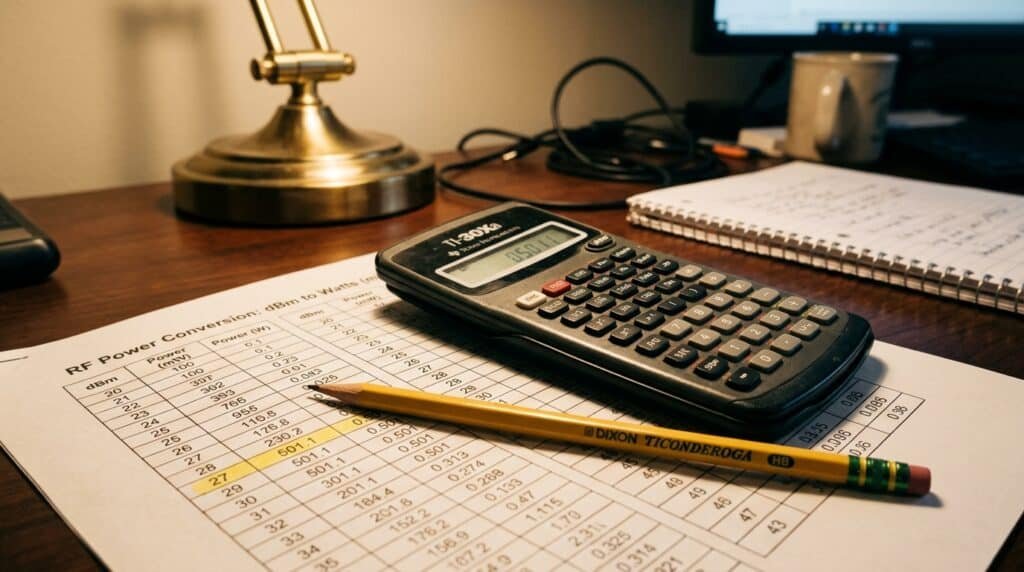
| dBm Value | Milliwatts (mW) | Watts (W) | Context |
|---|---|---|---|
| -10 dBm | 0.1 mW | 0.0001 W (100 µW) | Typical weak Wi-Fi receive signal |
| 0 dBm | 1 mW | 0.001 W | The reference point |
| 1 dBm | 1.259 mW | 0.001259 W | Just above the reference point |
| 3 dBm | 1.995 mW (≈2 mW) | 0.001995 W | The “double 0 dBm” checkpoint |
| 10 dBm | 10 mW | 0.01 W | Common Bluetooth/BLE transmit power |
| 20 dBm | 100 mW | 0.1 W | Typical Wi-Fi router transmit power |
| 30 dBm | 1000 mW | 1 W | The other anchor point |
| 40 dBm | 10,000 mW | 10 W | Point-to-point wireless bridge territory |
Worked Example, Step by Step, for 23 dBm
- Divide by 10: 23 ÷ 10 = 2.3
- Raise 10 to that power: 10^2.3 = 199.53
- That’s the answer in milliwatts: ≈199.5 mW
- Divide by 1000 for watts: ≈0.1995 W
dBm to Watts Conversion Table (Full Reference, Including Negative Values)
Most online converters only show the positive range. Receive-signal work lives almost entirely in negative dBm, so here’s the full picture:
| dBm | Power |
|---|---|
| +50 dBm | 100 W |
| +40 dBm | 10 W |
| +30 dBm | 1 W |
| +20 dBm | 100 mW |
| +10 dBm | 10 mW |
| 0 dBm | 1 mW |
| -10 dBm | 100 µW (0.1 mW) |
| -20 dBm | 10 µW (0.01 mW) |
| -30 dBm | 1 µW (0.001 mW) |
| -40 dBm | 100 nW |
| -50 dBm | 10 nW |
| -60 dBm | 1 nW |
| -70 dBm | 100 pW |
| -80 dBm | 10 pW |
| -90 dBm | 1 pW |
Notice the pattern: every 10 dBm step multiplies or divides by exactly 10. That’s the logarithmic scale doing exactly what it’s designed to do — turning multiplication into simple addition of exponents.
Watts to dBm: The Reverse Conversion
Going the other direction is just as common — you know a transmitter’s rated output in watts and need it in dBm to plug into a link budget.
dBm = 10 × log₁₀(Watts × 1000)
Worked example, for a 5 W amplifier:
- Multiply watts by 1000 to get milliwatts: 5 × 1000 = 5000 mW
- Take the base-10 logarithm: log₁₀(5000) = 3.699
- Multiply by 10: ≈37 dBm
| Watts | dBm |
|---|---|
| 0.001 W (1 mW) | 0 dBm |
| 0.1 W | 20 dBm |
| 1 W | 30 dBm |
| 2 W | 33 dBm |
| 5 W | ≈37 dBm |
| 10 W | 40 dBm |
| 100 W | 50 dBm |
dBm vs. mW vs. Watts vs. dBW: Keeping the Units Straight
These four units describe power, but they’re not interchangeable without conversion, and mixing them up is a genuinely common source of errors.
| Unit | What It Is | Reference Point | Example |
|---|---|---|---|
| Watts (W) | The base SI unit of power | Absolute — no reference needed | 1 W |
| Milliwatts (mW) | 1/1000 of a watt | Absolute — no reference needed | 1000 mW = 1 W |
| dBm | Decibels relative to 1 milliwatt | 1 mW = 0 dBm | 30 dBm = 1 W |
| dBW | Decibels relative to 1 watt | 1 W = 0 dBW | 0 dBW = 30 dBm |
The relationship between dBm and dBW is a fixed 30 dB offset, since 1 W is 1000 mW and 10×log₁₀(1000) = 30: dBm = dBW + 30, and dBW = dBm − 30. Satellite and some licensed-microwave specs favor dBW because their power levels are large; Wi-Fi, Bluetooth, and most unlicensed-band work favors dBm because their power levels are small.
dBm to Watts for Wi-Fi, 5G, LTE, LoRa, and Bluetooth
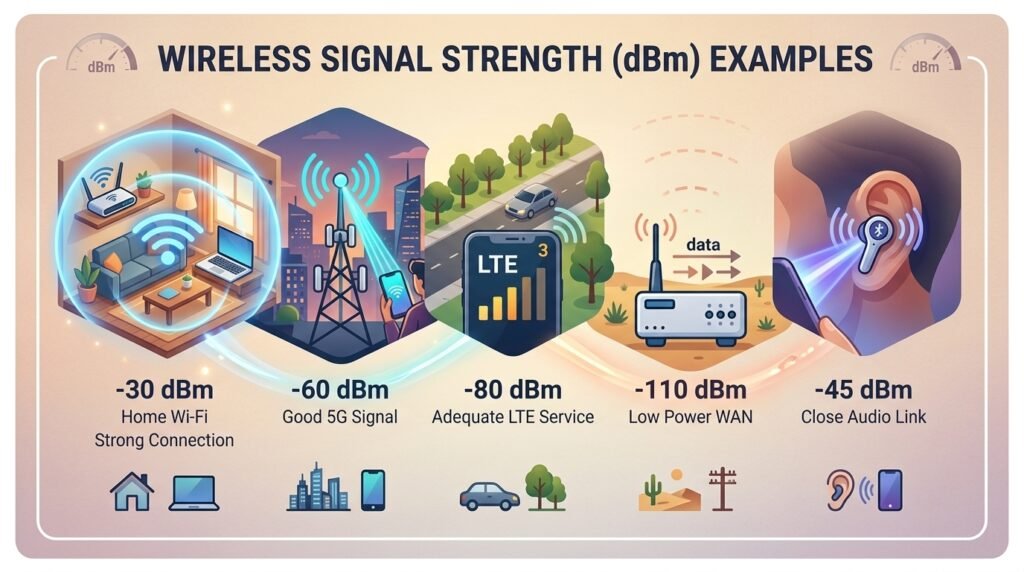
- Wi-Fi: Consumer routers typically transmit around 20 dBm (100 mW) per chain, though regulatory limits can allow more once antenna gain is factored in.
- 5G NR: Base station output varies enormously by deployment, with the actual EIRP toward a device shaped heavily by beamforming rather than raw transmit power alone.
- LTE/cellular handsets: Typically transmit in the low-to-mid 20s dBm range, with the network dynamically instructing the device to use less power to conserve battery and reduce interference.
- LoRa/IoT: Often runs as low as 10–14 dBm, achieving long range from very low transmit power through a highly robust modulation scheme rather than brute-force wattage.
- Bluetooth/BLE: Classic Bluetooth tops out around 20 dBm (Class 1) down to 0 dBm (Class 3); BLE devices are frequently even lower, prioritizing battery life over range.
If you’re working through a full transmit chain — power, cable loss, antenna gain — pair this converter with an EIRP calculator to get the effective radiated power rather than just the raw transmitter output.
Common dBm to Watts Mistakes

| Mistake | Why It Happens | How to Avoid It |
|---|---|---|
| Forgetting to divide by 1000 after the exponent | The formula gives milliwatts first; watts requires one more step | Always check whether the answer is supposed to be in mW or W |
| Treating dB and dBm as the same unit | Both use “decibel,” but dB is a ratio while dBm is an absolute power | dB alone can never convert to watts without an absolute starting power |
| Averaging dBm values arithmetically | dBm is logarithmic, so averaging two dBm numbers directly doesn't give the true average power | Convert to watts, average those, then convert back to dBm |
| Mixing up dBm and dBW | Both are absolute power units, but with a 30 dB offset between them | Always double-check which reference a spec sheet is using |
| Rounding too early in multi-step link budget math | Small rounding errors compound across several steps | Keep full decimal precision through intermediate steps; round only the final answer |
Frequently Asked Questions
Final Thoughts
Once the two anchor points — 0 dBm equals 1 mW, and 30 dBm equals 1 W — are locked in, the rest of this conversion becomes almost automatic. Every 10 dBm is a factor of 10, every 3 dBm is roughly a factor of 2, and the exact formula is always there for the moments that need precision rather than an estimate.
Whether you’re reading a spec sheet, building a link budget, or just satisfying your own curiosity about what your router is actually radiating, the calculator above will get you there in one step — and now you know exactly what it’s doing behind the scenes.
Related Calculators on SmartTeleNet
Publish these internal links once each companion page is live — do not link to URLs that don’t exist yet.
- EIRP Calculator — anchor text: “calculate your effective radiated power” →
/eirp-calculator/ - dBi to dBd Antenna Gain Converter — anchor text: “convert antenna gain units” →
/dbi-to-dbd-calculator/ - Free Space Path Loss / Link Budget Calculator — anchor text: “run a full link budget” →
/free-space-path-loss-calculator/ - Coax Cable Loss Calculator — anchor text: “calculate your cable loss” →
/coax-cable-loss-calculator/ - VSWR Calculator — anchor text: “check your antenna’s VSWR” →
/vswr-calculator/
External Sources Referenced
- Decibel — Wikipedia — general reference on the decibel scale and its logarithmic definition
- dBm — Wikipedia — reference definition and standard usage of the dBm unit
About the Author
Written by Jaweed — a retired electronics engineer based in Karachi, Pakistan, holding a Diploma in Electronics from the Government College of Technology (S.I.T.E., Karachi) and a Bachelor’s in Computer Science from Shah Abdul Latif University, Khairpur. Jaweed builds SEO-focused calculator tools and technical explainer content, drawing on a background in electronics engineering to keep the math and formulas accurate.
[Add a real contact/corrections email or contact-page link here before publishing.]